
CRM system for trading car and other vehicle parts
Facts checked: 2026-11-12
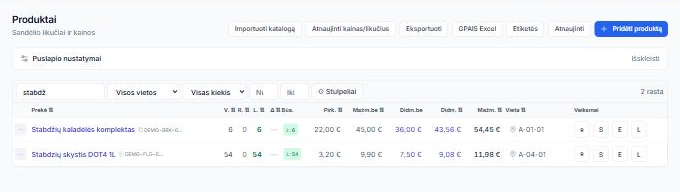
A customer calls and reads out not a product name but an OEM code off an old part -- with spaces, in capitals, maybe missing the last character that wore off years ago. Your salesperson has seconds to recognize this is the same brake disc listed under your own SKU, with three cross-reference equivalents from other manufacturers. In car, motorcycle and truck parts trading, this happens every single day -- thousands of SKUs, each with its own OEM code, supplier code and a handful of aftermarket equivalents, while the customer on the phone is waiting for "yes" or "no," not a promise to call back. This page explains how DSOLVER CRM turns that search chaos into one field that finds everything.
Why a generic sales CRM hits a wall here fast
One part, five possible codes. The same brake pad can carry a manufacturer OEM code, your supplier's (e.g. a wholesaler's) code, your own internal SKU, and two or three aftermarket equivalents from different manufacturers. If the system only searches by one of them, the seller either loses time searching by hand or, worse, tells the customer "we don't have it" when the part is sitting on the shelf under a different code.
Stock has to be now, not yesterday. A part sells over the phone, online and at the counter at the same time. If warehouse stock doesn't update instantly, that same last unit gets sold twice within the hour -- and someone has to call a customer back to apologize.
Supplier invoices arrive constantly, in bulk. A wholesaler (an Inter Cars-type distributor, for example) sends a 100-line PDF invoice several times a week -- if every line has to be entered by hand and matched to the catalog manually, receiving stock turns into a full day’s work, and stock stays wrong the whole time.
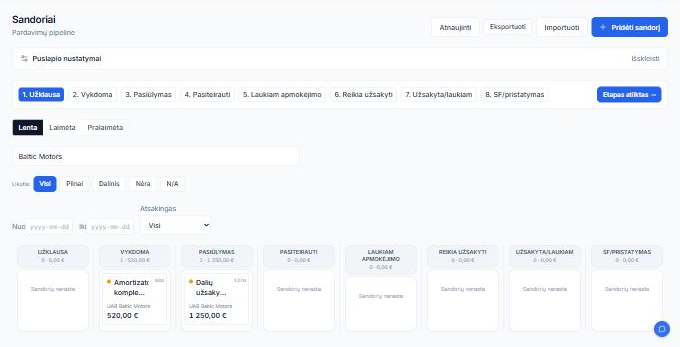
The same buyer wears three different hats. An end driver buys one part once a year. A service shop you work with regularly orders weekly at a discount. A reseller (another dealer) buys at wholesale prices and larger volumes. All three need to go through the same system, but get a different price without anyone calculating it by hand every time.
What DSOLVER CRM actually does
Search works by SKU, OEM code, supplier code, barcode or name all at once -- you don't need to know which format the customer is reading out, the system finds a match even for a short code, with spaces, or missing a trailing character.
A wholesaler’s invoice is imported from PDF in a couple of minutes -- line items are automatically matched to the existing catalog, with stock updated on receipt, with no manual retyping of a hundred lines.
When a delivery arrives short or with a damaged part, you flag it against that exact line on the same purchase invoice right away -- the claim to the supplier comes with a real record, not a memory of what happened a week ago.
Each customer -- end buyer, service shop or B2B reseller -- gets their own pricing set up once, and B2B partners see only their own price and stock in real time through the self-service portal, with no call to your team.
Stock updates the instant a sale happens, whether it came by phone, online or at the counter -- all three channels see the same, real number.
What this actually changes day to day
- A customer reading out an old OEM code on the phone gets an answer in seconds, not after a search across several catalogs
- You stop selling the same last unit twice -- stock is identical for the phone, the webshop and the counter
- A hundred-line supplier invoice gets received in minutes, not an entire workday
- A service shop, a reseller and an end buyer each get the right price automatically, with no manual calculation on every call
- A B2B partner orders themselves through the portal, seeing real stock -- no more calling to ask if a part is still available
- Aftermarket equivalents are found automatically -- fewer "we don’t have it" answers when you actually do, just under a different code
- Need the catalog structure fitted to a new parts category? Changes happen in days, not months, the way they would on a classic system
Who this is for
- Car spare parts retailers and wholesalers
- Motorcycle, ATV, lawnmower and other garden/small-engine equipment parts sellers
- Truck and trailer parts suppliers
- Businesses combining parts trading with service work in the same system
Is this relevant to you: a quick test
If you answer "yes" to at least two of these, a specialized warehouse+CRM system is worth considering:
- □Do you have 500+ distinct parts/SKUs with OEM or supplier codes?
- □Are you currently entering supplier purchase invoices into stock by hand?
- □Do different customers (service, wholesale, end buyer) need different prices?
- □Do customers often call or email asking "is it in stock" because the system doesn't show real stock?
Frequently asked questions
Does the system recognize parts by OEM code, not just its own SKU?
Yes, search works by SKU, OEM code, supplier code and barcode at once, including short codes with spaces or hyphens.
Can purchase invoices be imported from PDF?
Yes, PDF invoices are imported and line items are automatically matched to the existing product catalog, with stock updated on receipt.
Can I set different prices for different customer types (B2C, service, wholesale)?
Yes, each customer or customer group can have its own pricing, and B2B partners see only their own prices in real time through the self-service portal.
Does it work if I combine parts trading with service work?
Yes, the same system covers service reception and work orders linked to the same products and customers.
Which plan includes the warehouse and B2B portal features?
Real-time stock and search by OEM/supplier code are part of the Business plan (€349/mo). The B2B self-service portal for resellers is part of the Enterprise plan (from €699/mo). Both come with the first 2 months free to trial the standard system.
Related pages
Do you trade vehicle parts?
In a short call, tell us about your stock volume and suppliers -- we'll show you how it would look in your own process.