
CRM with warehouse management: why separate systems stop working
Facts checked: 2026-11-01
Sales in one system, stock in another, invoices in a third — and every number has to be entered by hand at least twice. This article explains why that setup breaks down as a company grows, and what "integrated warehouse" actually means in a system, not just a marketing phrase.
Why separate CRM and warehouse systems stop working
Most sales CRMs (including popular international ones) are built for managing deals and contacts — not stock levels. While product counts are low or sales are slow, a separate spreadsheet or basic accounting tool for the warehouse works well enough. The problem starts once these two data sources start living separate lives.
- A salesperson sees a stock figure in the CRM that no longer matches reality in the warehouse
- Warehouse staff write off a product on paper or in a separate tool, and sales find out late
- The same customer or product exists in two or three systems with different data
- At month-end, sales, warehouse and accounting figures need to be reconciled by hand
- Nobody can say, at any given moment, exactly how much stock is actually free — only roughly
What this actually costs a business
The cost of separate systems is rarely visible as one number — it's spread across many small losses that add up:
- A product sold that is no longer actually in stock — a broken promise to a customer
- "On paper" sold stock still physically sitting in the warehouse, tying up capital
- Staff time spent reconciling numbers instead of selling or serving customers
- Errors from entering the same data twice across systems
What "integrated warehouse" actually means in a CRM
"Integrated warehouse" does not just mean a warehouse module exists in the same product. It means sales and warehouse operate on the SAME database in real time, not through a periodic export/import between two systems. DSOLVER CRM implements this as follows:
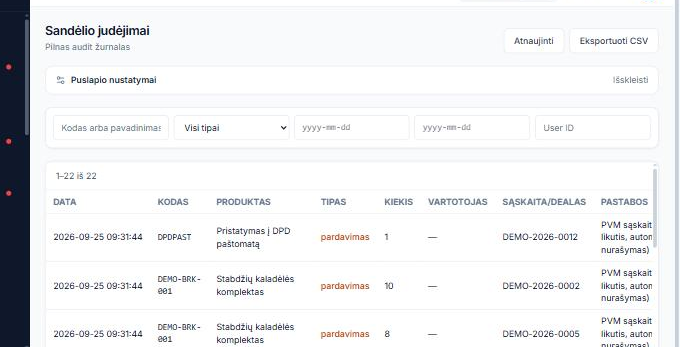
- Closing a deal automatically reserves or deducts stock — no separate step in another system
- Warehouse staff work with barcode scanning on a phone or tablet — receiving, packing, moving stock between locations
- Multiple warehouses or branches are visible in one system, with their own stock locations
- Inventory counts happen in the same system, not a separate spreadsheet
- B2B partners see the real, current stock level through the self-service portal — not yesterday's data
Critical stock levels and supplier orders — not after you've already run out
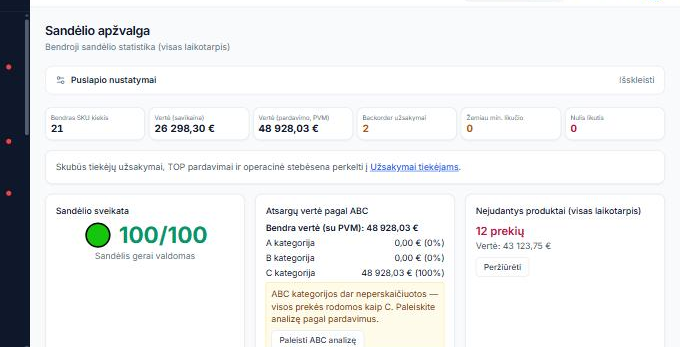
An integrated warehouse means not just "how much is here now" but "what will I need soon." The warehouse dashboard shows an overall warehouse health score at a glance, how many products have already hit a critical stock level, and how much capital is tied up in slow-moving stock that isn't selling — one place for the whole picture, not a separate spreadsheet calculation once a month.
The system works out each product's monthly sell-through rate and shows how many months of stock are left at that pace -- one-off, one-time sales are excluded from the calculation so the list doesn't fill up with noise. A manager marks an item as ordered with one click, the system shows an expected delivery date, and the whole list can be copied straight into an email to the supplier, no retyping.
The result -- fewer moments where a customer asks for a product that's been out of stock for a week, and less money frozen in items that just sit on a shelf for months without moving.
Reports show the top 20 best-selling products and top 20 customers by revenue at a glance, with units sold and the last invoice date -- a manager doesn't have to calculate or guess what actually drives revenue versus what's just taking up shelf space.
The system watches its own data and flags what doesn't add up -- an invoice marked paid with no matching sale recorded, or a deal marked delivered that was never actually reserved from stock. That gets caught automatically, not a month later when the bookkeeper stumbles onto the mismatch by hand.
Who actually needs an integrated CRM+warehouse solution
Integrated warehouse management becomes important once a business matches at least one of these:
- Trading physical goods (spare parts, equipment, machinery) with hundreds or thousands of SKUs
- Multiple warehouses, branches or service locations that need one shared view
- Sales happening across several channels at once — online store, B2B partners, direct sales
- Service or repair work that draws parts from the same warehouse sales uses
- Partners or customers who want to see real stock themselves, without calling the company
When an integrated warehouse isn't a priority
Honestly: if you only sell services or digital products with no physical warehouse, or your product range is very small and managed by one person, a dedicated warehouse module likely won't add value — a simple sales CRM may be the faster, cheaper choice.

How to tell if a CRM's "warehouse" is actually integrated
Ask the vendor, or check yourself, against these points:
- □Does a sale automatically affect stock, or does it need a separate manual step?
- □Can warehouse staff scan barcodes from a phone/tablet, or only from a desktop?
- □Are multiple warehouses/branches visible in one system, or do you need separate licenses/systems for each?
- □Are inventory counts done in the same system?
- □Do B2B partners see real, not periodically refreshed, stock levels?
- □How long does syncing take between sales and warehouse data — seconds or hours?
Frequently asked questions
Does DSOLVER CRM have integrated warehouse management?
Yes. Real-time stock, mobile barcode scanning, multiple warehouses and stock locations are all managed in the same system as CRM and sales, with no separate export/import between systems.
Can warehouse work happen without a computer, just a phone?
Yes, warehouse work (receiving, packing, stock movements, inventory counts) runs on a phone and tablet with a barcode scanner.
Do partners see real stock through the B2B portal, or just an estimate?
The B2B portal shows the stock level currently in the system, since it updates from the same data source as internal warehouse management, not a separately exported figure.
Can multiple warehouses or branches be managed in one system?
Yes, multiple warehouses/branches and their stock locations are visible and managed in one system.
Do I need to migrate existing stock data from Excel?
During rollout we help migrate existing customers, products and stock from Excel or a legacy system — this is discussed individually based on your situation.
Which plan includes the warehouse and B2B portal features?
Real-time warehouse management, mobile scanning, multiple warehouses and critical-stock alerts are part of the Business plan (€349/mo). The B2B self-service partner portal is part of the Enterprise plan (from €699/mo). Both come with the first 2 months free to trial the standard system.
Related pages
Want to see the warehouse module live?
In a short call we'll show you how stock reservation, mobile scanning and B2B stock visibility work for your scenario.